Lloyd’s Register strengthens partnership with Echo Marine Group to deliver Western Australia’s first electric ferry fleet
The project marks a major step forward for sustainable public transport in Australia and sets a new standard for low emission ferry design and construction.
Lloyd’s Register (LR) has signed a new contract with long-standing partner Echo Marine Group to support the delivery of Western Australia’s first fully electric passenger ferries - marking a major milestone for sustainable public transport in Australia.
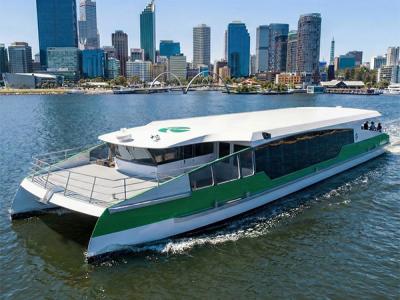
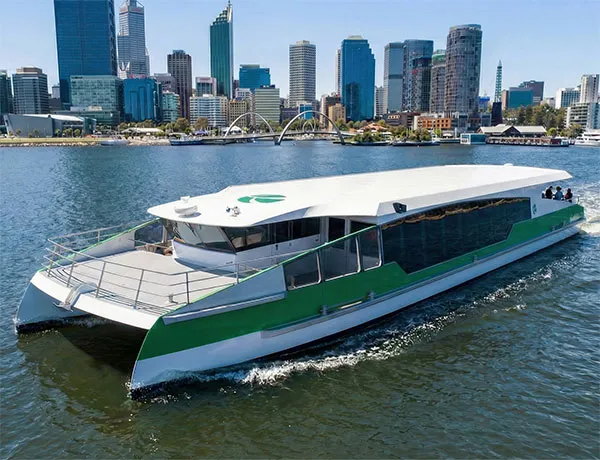
The project, which is a part of the Perth Transport Authority’s (PTA) METRONET Swan River Ferry Service Expansion programme, will see the design and construction of five new battery-electric ferries for operation on Perth’s Swan River. LR will provide classification and technical assurance services throughout the design and build, supporting the safe introduction of this new generation of zero-emission vessels.
Building on an established working relationship, LR and Echo Marine Group are collaborating closely to bring first-of-its-kind electric propulsion technology into public transport service in Australia. The programme sets a new benchmark for zero-emission ferry design and construction in the region.
As one of the first fully electric ferry fleets in Australia, the project presents unique technical and regulatory considerations, including high-voltage battery integration, evolving standards and the safe deployment of new propulsion systems in a public transport environment. LR’s early involvement helped define a clear approval pathway, ensuring that technical decisions were validated from the outset and aligned with emerging requirements for electric vessels.
An initial first step of LR’s role has been proactive technical engagement. Through structured workshops, and regular stakeholder sessions, supported by LR’s global Technical Support Office.
Drawing on its global experience across electric and hybrid vessel projects, LR has also shared international reference cases and practical insights to benchmark the design against proven solutions. This has provided additional confidence in critical areas such as battery safety systems, system integration and operational performance.
In Perth, LR’s local surveyor team is working alongside Echo Marine throughout construction, providing on-site oversight during installation of the electric propulsion systems, high-voltage cabling and associated safety systems. The combination of strong on-the-ground presence and global technical depth ensures seamless assurance from concept to commissioning.
Asif Ghauri, Account Manager, Marine – Australasia, Lloyd’s Register, said: “The strength of our long-standing relationship with Echo Marine Group has enabled us to move forward with confidence on this pioneering project. By combining local insight knowledge with regional and global expertise, we are providing end-to-end assurance that supports safety, compliance and innovation.”
Anthony Livanos, Project Manager, Echo Marine Group said: “Our collaboration with Lloyd’s Register has been instrumental in reducing uncertainty around regulatory interpretation and safeguarding passenger safety, vessel efficiency, and delivery timelines. As governments across Australia and New Zealand accelerate decarbonisation efforts, this project showcases how close cooperation between owner, builder and class can successfully bring new technology into service.”
The programme is expected to provide a scalable model for future low-emission ferry developments across the region, with the first of the new electric vessels scheduled to enter service in 2027.
Lloyd’s Register’s Fuel for Thought: Electric explores the role of electric power and electrification as part of the maritime industry’s transition to lower‑ and zero‑emission operations. It examines how electric propulsion systems can deliver improved energy efficiency, reduced emissions and lower noise and vibration for certain vessel types and operating profiles. The research helps shipowners and designers understand where electrification is most technically and commercially viable today, and how it can be safely integrated into future vessel designs.